Only around one-third of Americans are satisfied with Donald Trump’s policies, the lowest level of his second term, according to recent reports. That does not come as a surprise. The US president appears weakened by a series of controversies, from alleged links to Jeffrey Epstein and the Iran conflict to criticism from the Vatican, persistent inflation, Viktor Orban’s electoral defeat and further domestic disputes. The list could be extended.
Even so, the approval ratings of the American head of state appear high when set against those recorded for German Chancellor Friedrich Merz after less than a year in office.
According to a survey by the polling institute INSA, only about one in five Germans are satisfied with Merz’s performance (21%) or with the work of his government (20%). A majority of voters across all parties, including supporters of the governing coalition, are dissatisfied with the federal government. The comparison underscores how serious the situation has become.

Credibility Crisis
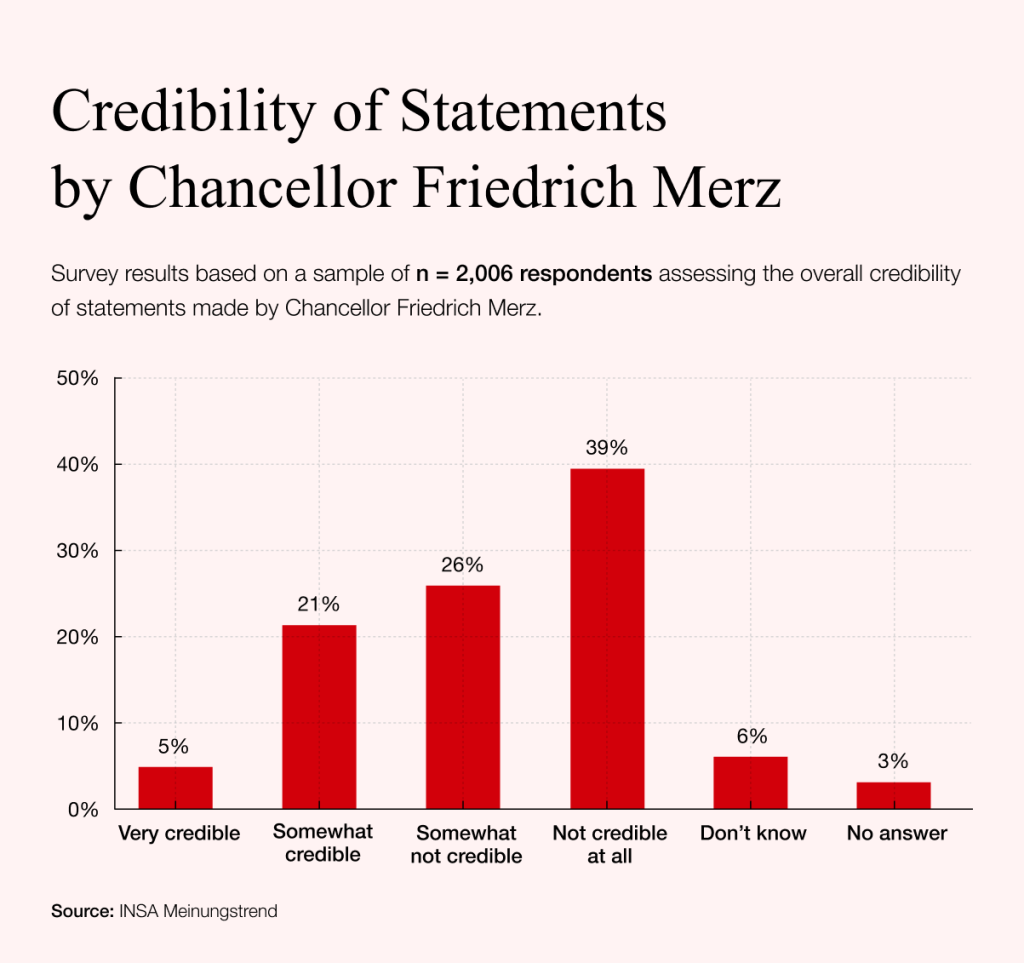
Improved communication and even rapid policy initiatives are unlikely to reverse the trend, at least not quickly. Some 65% of respondents in the INSA survey say they generally consider statements by the chancellor not credible.
Only one in four (26%) believe them. In eastern Germany, the figures are even worse than in the west. There, only 18% still trust statements made by their chancellor, while 74% view them as not credible. In the west, 63% express doubts about his statements, compared with 28% who trust them.
Only among voters of his own party, the Christian Democratic Union and its Bavarian sister party (CDU/CSU), do more than half still consider his statements credible. Among supporters of all other parties, including those of his Social Democratic coalition partner (SPD), a majority do not believe them.
Broken Election Promises
The loss of trust runs deep. The CDU’s failure to deliver on key campaign pledges is now taking its toll. The promised sharp shift in migration policy has not materialized. The effective suspension of Germany’s constitutional debt brake through the creation of so-called special funds has called into question the CDU’s traditional strength in economic and fiscal policy and instead led to a surge in borrowing.
The promised “autumn of reforms” for autumn 2025 did not take place. It was not even postponed, but simply abandoned. At the same time, debates about potential tax increases, which had previously been ruled out, have added to concerns, alongside an economic downturn and rising energy prices.
Effort No Longer Guarantees Success
At the core of the mistrust lies a deeper experience: the sense that the promise of social mobility, which defined the Federal Republic for decades during its post-war economic boom, no longer holds without qualification. Only one in two respondents (51%) still agree that anyone in Germany can achieve upward mobility through personal effort. One in three (32%) deny that such a promise exists at all.
That marks a profound shift in public confidence. Many no longer believe that success can reliably be achieved through hard work or that their children’s generation will be better off than their own.
The older the respondents (63%) and the higher their monthly net household income (65%), the more likely they are to say that the promise of upward mobility still applies.
A breakdown by party affiliation reveals clear divides. Some 74% of voters of the Christian Democratic Union (CDU/CSU), 65% of the Free Democratic Party (FDP), 61% of the Social Democratic Party (SPD) and 58% of the Greens say upward mobility through effort remains possible, compared with 45% of supporters of Alternative for Germany (AfD), 39% of Left Party voters and 37% of the Sahra Wagenknecht Alliance (BSW).
This divide is significant. The strength of open societies rests in part on the belief that effort can lead to advancement. The fact that voters at both ends of the political spectrum increasingly reject that idea highlights the scale of the problem.
Growing Anxiety About the Future
All political actors would do well to take seriously the growing concern that a majority of Germans (54%) are worried about their personal future. The younger the respondents, the more likely they are to express concern, ranging from 46% among those over 70 to 58% among those under 30.
Across all age groups, among men and women, in both eastern and western Germany, and regardless of political orientation, those expressing concern form a majority.
Only among respondents with a monthly net household income of 4,000 euro or more (50%) and among voters of the CDU/CSU (49%) is concern less widespread. Even within those groups, however, around four in 10 respondents report significant worries about their personal future.
Anyone seeking to reverse the political mood will have to restore confidence. That confidence cannot be created through rhetoric alone. People need to experience it before it can be captured in opinion polls.
Germany’s Economy Compared with Europe
Concerns about the broader economic outlook are widespread. The economy remains the dominant issue for voters. INSA asked respondents to compare Germany’s economic development with that of other European countries.
Nearly two-thirds (65%) believe that Sweden’s economy is developing better than Germany’s. Some 15% see similar performance, while only 6% believe Sweden is doing worse. When comparing positive and negative assessments, more respondents believe that Poland (32% better, 24% worse), Spain (29% better, 17% worse) and France (23% better, 18% worse) are outperforming Germany.
Opinions on Italy are divided, with 24% saying it is doing better and 22% worse.
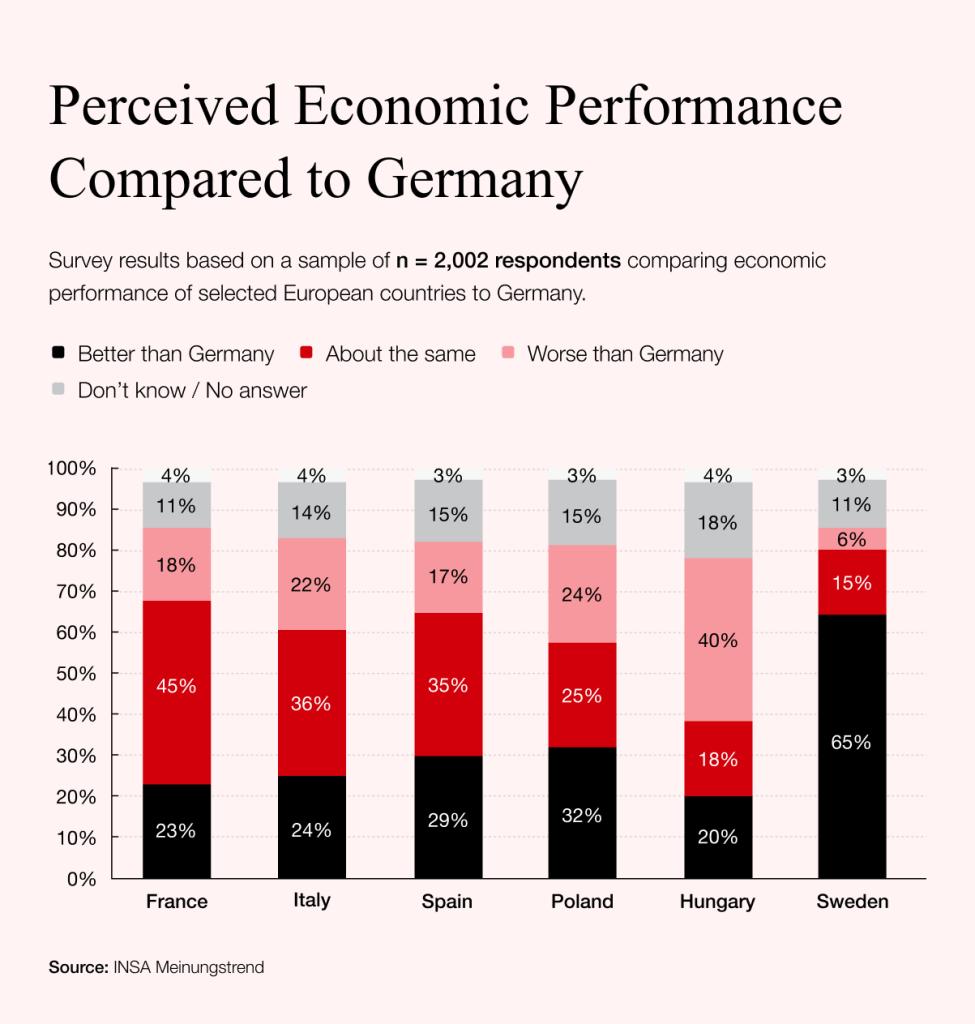
Only in the case of Hungary do twice as many respondents (40%) believe the economy is performing worse than in Germany, compared with 20% who think it is doing better. Yet here, too, a closer look is revealing. While only about one in 10 voters of the CDU/CSU, SPD, Greens and the Left Party believe Hungary is doing better, nearly half of AfD voters (48%) are convinced that Hungary’s economy is outperforming Germany’s.
The Economy as the Decisive Issue
Recent parliamentary elections in Hungary underline the point. Neither questions of war and peace nor broader cultural divisions proved decisive. Instead, the key factor was economic performance.
Those in Europe, and especially in Germany, who welcomed the Hungarian result as an endorsement of a particular political programme may yet conclude that it was primarily an expression of dissatisfaction with economic conditions, both personal and national. That challenge spares no country.
“It’s the economy, stupid!” With that campaign slogan, Bill Clinton won the US presidential election 35 years ago, defeating the incumbent George Bush, who had only shortly before enjoyed approval ratings of 90%. The economy is not always the decisive factor in elections. At present, however, it is.
The decisive issue, in Germany as elsewhere, remains the economy. Voters will ultimately back those they trust to lead the country out of crisis and improve living standards.
Those who ignore it, or fail to provide convincing answers, will lose.