
Shortly before Pope Leo XIV’s visit to Spain, a group of Masonic, atheist and secularist organizations launched a campaign under the slogan “I Am Not Waiting for You”. One of its leading figures is Joan Francesc Pont Clemente, a professor of financial and tax law at the University of Barcelona and a 33rd-degree Freemason.
In the initiative’s manifesto, the organizers expressed dissatisfaction that a visit of a religious nature was “being treated by the institutions as a state visit, with the resulting use of public funds”.
The campaign argues that this “undermines institutional neutrality and promotes privileged treatment that contradicts the constitutionally recognized principle of state neutrality”.
The organizers are calling for an end to public funding for papal events, the exclusion of state representatives from religious services and the abolition of the concordat between Spain and the Holy See.
A Secularist Protest
The group has called a protest rally for 9 June on Passeig del Born, a well-known street in central Barcelona. It is due to begin at 7 p.m. The timing is deliberate: one hour earlier, Pope Leo XIV is scheduled to begin his Barcelona itinerary with a prayer vigil at the Olympic Stadium.
Observers say the Pope’s visit to Spain comes at a moment of acute political and social tension. The country is increasingly divided and polarized.
The tensions have been heightened by an unprecedented development in modern Spanish democracy: former socialist prime minister José Luis Rodríguez Zapatero is under criminal investigation over alleged corruption. He was the Spanish prime minister during Pope Benedict XVI’s visit 15 years ago.
The situation also affects the government of Prime Minister Pedro Sánchez, who met the Pope at the Vatican on 27 May. His cabinet is facing criticism even from its own coalition partners. The Basque Nationalist Party has called it “irresponsible” that the government has still not called early parliamentary elections.
Cardinal José Cobo, the archbishop of Madrid, played down the possible consequences of the scandal for the papal visit. In an interview with EWTN, he said the Church was used to operating amid political turbulence: “It is simply part of life. The headlines change every day.”
Fractured Families
Polarization, however, has long since ceased to be a purely political matter. It has reached deep into society.
According to the Polarization Atlas 2025 by More in Common, an international research group focused on social cohesion, nearly five million Spaniards, around 14% of the population, have broken off personal relationships because of ideological disputes. Three in five citizens also prefer to avoid political debate in order to prevent conflict.
Roman law professor Rafael Domingo Oslé warns that this represents a serious disruption of public space. In his view, Spain is living through a period of deep social fragmentation, made worse by a political class unable to moderate the aggressive tone of public debate.
“When people stop respecting each other, society begins to disintegrate”, the lawyer warns.
A Different Tone from Rome
That is why the Pope’s visit carries particular importance. Not as an immediate solution to the crisis, but as a voice capable of bringing a completely different tone to public debate.
“One papal visit will not solve the crisis. But it can offer something that politics can no longer do: a common language and a common space”, Domingo explains.
The Pope, he says, is not coming as an arbiter of ideological disputes, but as a shepherd who reminds people that every person has dignity, regardless of how they vote.
That has created an exceptional situation: both chambers of the Spanish Parliament have unanimously invited the Pope. In a country where political consensus is almost impossible, the gesture is highly symbolic.
Pope Leo XIV will address a joint session of the Spanish Parliament on 8 June, becoming the first pope in history to speak before both chambers.
The motto of the visit, “Lift up your eyes”, captures the main message, according to the organizers: to stop focusing only on endless conflicts and look instead at what is essential.
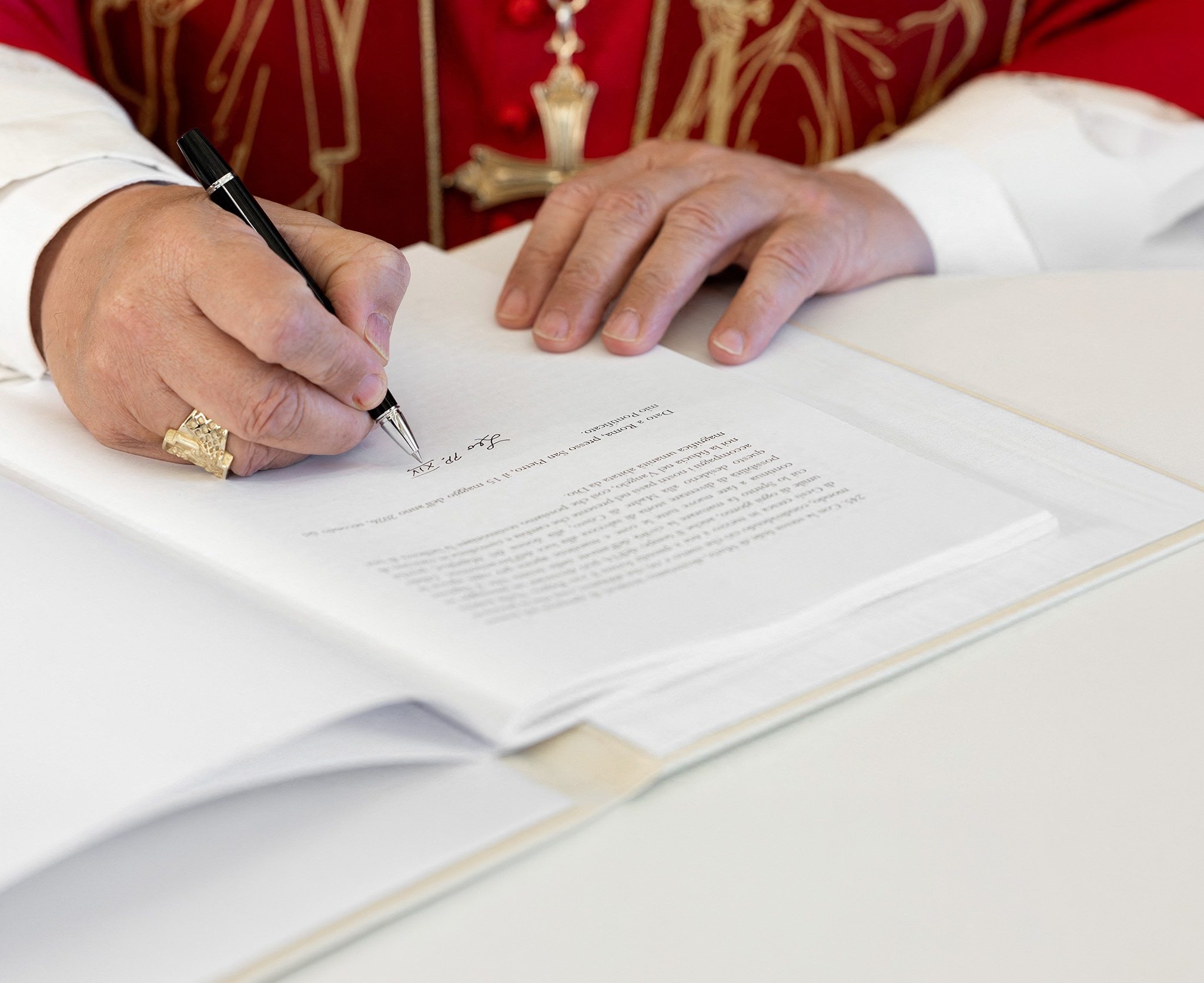
The encyclical Magnifica Humanitas has also attracted considerable attention in Spanish politics. Sánchez stressed on X that the document highlights the risks of artificial intelligence, digital power and the need to protect human dignity.
Tensions Between the State and the Church
Despite some common themes, relations between the state and the Church remain tense. One of the biggest disputes concerns the transformation of the Valle de los Caídos monument, the vast complex associated with the civil war and the dictator Francisco Franco.
The current government wants to turn the site into a center of democratic memory, while the Church stresses the need to preserve its religious character.
Conflicts have also arisen over abortion and proposals to abolish military chaplaincy. Criticism does not come only from the left, however. Conservatives have also attacked the bishops over their support for migrants and the legalization of the status of hundreds of thousands of immigrants.
Fear That the Pope’s Words Will Be Misused
In such a polarized environment, there is also a risk that different political camps will interpret the Pope’s words for their own purposes.
“Everyone will just pick and choose what suits them”, Domingo warns. He adds, however, that the Vatican has long experience in formulating speeches that can withstand being taken out of context.
Cardinal Cobo expressed similar concerns. In his view, it would be a mistake to reduce the Pope’s words to a partisan fight. “The Pope is talking about politics with a capital P: about the common good, not about party wars”, he stressed.
Another issue is the rise of identitarian politics, which uses Christianity as a cultural symbol in the fight against Islam or migration. Sociologist Rafael Ruiz Andrés points out that the misuse of Christianity for political ends is one of Pope Leo XIV’s main concerns.
After the Pope’s meeting with the bishops, reports said the Vatican had warned against attempts to “instrumentalize the Church”. It was later clarified, however, that the Pope had spoken in general terms about the risk of subordinating faith to ideologies.
Pope Leo XIV will be in Spain from 6 to 12 June. Under the Gospel motto “Lift up your eyes” (John 4:35), he will travel to Madrid, Barcelona and the Canary Islands. In Barcelona, alongside the prayer vigil, he is scheduled to consecrate the highest tower of the Sagrada Família Basilica, the Tower of Jesus Christ.
This text was originally published on DoKostola.sk, a Slovak Catholic website.