
The visit of Reza Pahlavi, son of the last Iranian monarch, to Berlin on Thursday this week was intended to rally support for the Iranian people’s struggle for freedom.
While more than 9,000 people demonstrated around the Reichstag for regime change in Iran, according to police figures, Berlin’s political establishment – and above all the German government – remained cautious. Officials were clearly determined to avoid creating the impression that Germany was taking sides on Iran, backing the Shah’s son or intervening in negotiations surrounding the war.
German Foreign Minister Johann Wadephul stressed that Pahlavi was entering the country as a private individual and that talks with him were not a matter for the government. Government spokesman Stefan Kornelius also moved quickly to confirm that, despite German reservations, the leadership in Tehran remained the German government’s counterpart.
Armin Laschet, the Christian Democratic Union (CDU) former chancellor candidate and now a member of the Bundestag’s foreign affairs committee, nevertheless met Pahlavi together with other CDU representatives for informal talks. Pahlavi is positioning himself as a transitional president and says he wants to establish a “secular democracy” in Iran.
A Street Attack and Political Distance
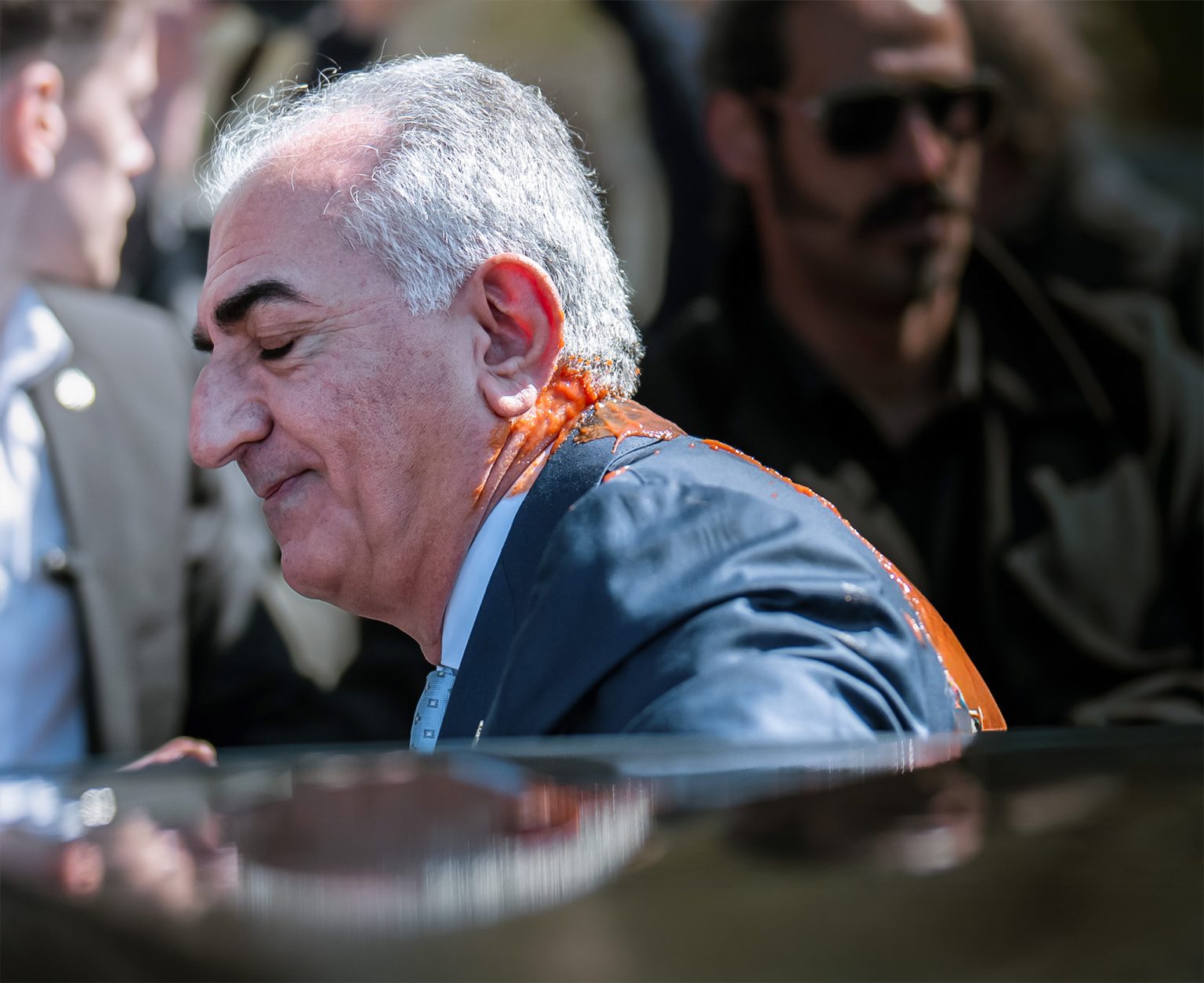
Despite extensive security precautions and personal protection, Pahlavi was attacked in public. A man threw a red liquid at him, which later turned out to be tomato sauce. Police quickly overpowered the attacker, who is now facing charges of assault.
Pahlavi then appeared at the Federal Press Conference in Berlin, where he faced at times highly critical questions from numerous journalists.
He repeatedly stressed that the Iranian population seeks an end to the mullah regime and urged European governments to stop appeasing or negotiating with its leadership. The regime, he said, must no longer be legitimized, because “when legitimacy dies, power begins to crumble”.
He openly criticized the fact that the suffering of the Iranian people has been pushed into the background during the current conflict, while other interests dominate the discussion.
“After years of oppression, millions of Iranians rose up in January. Tens of thousands died. But they did not die for a nuclear deal. They also did not die for reforms and more of the same. They died for freedom and for the liberation of their country.”
Pahlavi claimed that unimaginable atrocities were being committed against the population, but that news from inside the country was struggling to emerge because of internet shutdowns. Security forces, he said, had killed wounded people in hospitals. Since the beginning of the protests, tens of thousands of people had been buried in anonymous graves.
Medical staff who treated regime opponents had also been persecuted and killed, he said. In the past two weeks alone, 19 people had reportedly been executed for critical statements.
Sharp Criticism of German Media Coverage
Pahlavi also did not spare German media coverage of the Iran war from criticism. While the consequences of the war and possible war crimes by Israel or the United States were being widely reported, and representatives of the regime were being given space in the debate, he argued that the protest movement of the Iranian people had largely disappeared from view.
He sharply rejected media attempts to portray parts of the mullah leadership as “pragmatists”, saying they were merely different faces of the same regime. “There will never be stability, even if a watered-down version of this system survives.”
At the same time, he argued that the leadership in Tehran had never been as weak as it is today. Some media reports, he said, seemed “as if they came from another planet”.
When asked by a reporter whether he was an Israeli “asset”, Pahlavi responded with a historical reference, saying Iranians were proud that the country had offered persecuted Jews safe refuge during the Second World War.
He said he was of course not an Israeli asset. “But I am a friend of Israel and of the Jewish people.”