
The main driver of markets over the past five weeks has been Donald Trump’s account on his own social network. The mechanism is simple. The US president announces that a deal with Iran is practically on the table. Oil prices fall sharply and US equities rally. Iran denies such agreements and rejects any possibility of dialogue.
Subsequently – sometimes within a single day – Trump threatens to return Iran to the Stone Age. Tehran responds that any bombing of civilian infrastructure would be met with retaliation in other Gulf states. Oil prices surge again and both US and European shares fall.
And so the cycle repeats. It would be easy to profit from these swings if the mood of the US president could be timed precisely.
From energy shock to economic downturn
But the cycle has a fundamental problem: the energy shock is slowly turning into an economic shock. That development cannot be resolved by a short-term calming of market sentiment.
The blockage of the Strait of Hormuz is a structural problem. Disruptions to oil supply chains will lead to a measurable slowdown in global economic growth. The consequences of such a macroeconomic shock will affect the global economy across the board, but with significant regional asymmetry.
From Europe’s perspective, the situation is risky, even if direct dependence on oil supplies via Hormuz is lower than in many Asian economies. Europe’s main vulnerability lies not only in the physical volume of raw materials flowing through the region, but above all in its exposure to global energy pricing.
Following the move away from Russian pipeline gas, European energy security is far more closely tied to the global market for liquefied natural gas (LNG) and thus to its volatility. Significant supply shortfalls from the Middle East would prompt Asian economies to compete more aggressively for available volumes of oil and LNG, quickly increasing pressure on the global market.
Europe would therefore not face an immediate physical shortage, but would very likely become one of the main victims of a new price shock.
The problem is that Russia does not currently have the capacity to offset such a large global gas shortfall. China, meanwhile, is seeking to cover a larger share of its demand with Russian energy. By securing additional pipeline supplies, Beijing would strengthen its domestic position and gain greater flexibility in global markets.
China could then act in a way similar to Germany in the past, using cheaper long-term supplies at home while redirecting more expensive volumes elsewhere. The resulting tightening of global supply would gradually turn an energy shock into an economic one. Higher prices would feed through to European markets and again expose the structural vulnerability of European industry.
According to current estimates, Germany, the region’s main economic engine, could see GDP growth fall by up to 1.7 percentage points – a shock comparable to 2022 and 2023. The Italian economy is likely to enter a phase of stagnation.
In France, models indicate a halving of economic growth, accompanied by an increase in the budget deficit above 5.5 per cent. The resulting macroeconomic slowdown in these key economies would trigger negative spillover effects across the European Union, including export-oriented countries.
In the Asia-Pacific region, fundamentals are similarly negative. Japan and South Korea have a critical dependence on the Strait of Hormuz, with 72 per cent and 65 per cent of their oil imports respectively passing through it. Emerging economies such as Thailand and the Philippines would face a dual shock.
First, rising energy costs would place significant pressure on the balance of payments and push up food prices through more expensive fertilisers. Second, these markets face the risk of large outflows of foreign capital.
As geopolitical and economic uncertainty increases, institutional investors tend to reallocate assets to so-called safe havens, potentially destabilising local financial markets. That risk is not yet fully reflected in markets, particularly in Europe. Equity markets remain resilient, but this could change quickly.
Private credit bubble under strain
Iran should not, however, obscure other risks in equity markets. These include artificial intelligence, Japan and private company debt. While artificial intelligence and Japan’s demographic and economic problems remain smouldering threats that markets have largely absorbed, the private credit bubble has already entered a pressure phase.
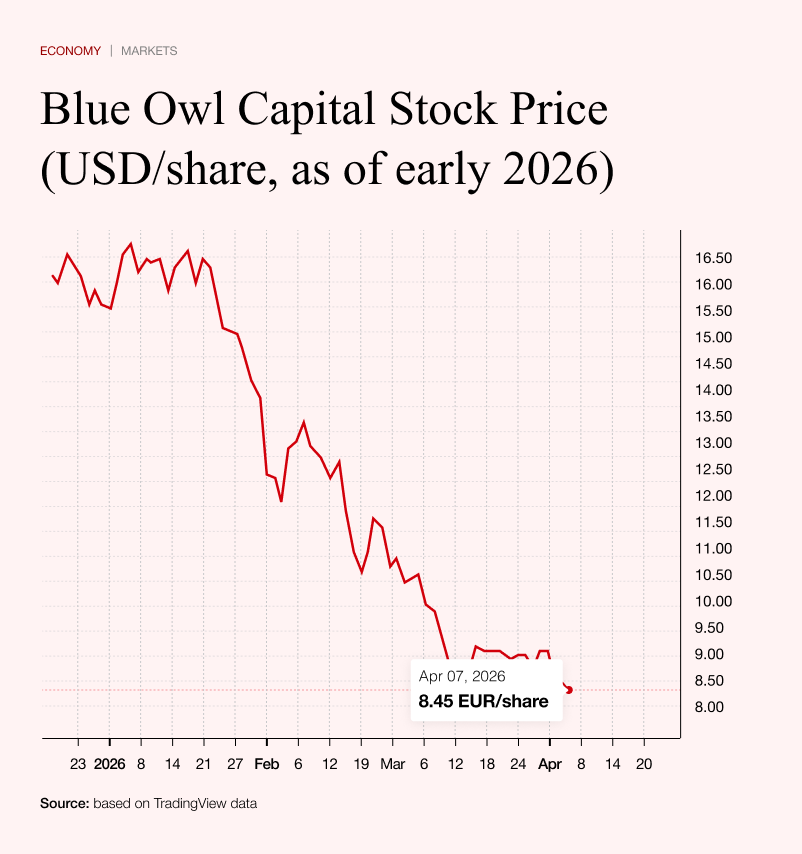
Blue Owl Capital is emblematic of the decline in this sector, although the turmoil is affecting better-known names such as BlackRock and Blackstone. New data from Blue Owl Capital illustrates the scale of the problem. Wealthy clients are attempting to withdraw money from funds en masse.
In the first quarter alone, investors requested $5.4 billion in withdrawals, which for some funds represented more than 40 per cent of total capital. These redemptions amounted to 22 per cent of Blue Owl Capital’s flagship private lending fund, valued at $36 billion, and 41 per cent at a separate technology-focused fund.
Blue Owl Capital had already limited withdrawals several months ago. Even under those restrictions, it would now take more than two years to meet client requests. The fear is spreading and triggering a chain reaction across the industry. More than $11 billion has flowed out of private credit funds over the past two quarters.
The US Treasury has already convened a meeting with regulators to discuss risks in the private credit sector, including proposals to include such assets in US 401(k) retirement plans.
The Iranian crisis further complicates matters, as Gulf petromonarchies are heavily invested across US markets. Those states may now need to make substantial domestic investments to repair damage caused by Iranian missile attacks. A private credit crunch could therefore become the trigger for a broader market correction.
The sad story of arms manufacturer CSG
Legendary value investor Benjamin Graham regarded IPOs as a tool that ultimately enriches sellers and intermediaries rather than buyers. Commenting on later editions of Graham’s work, financial journalist Jason Zweig noted that IPO could stand for ‘It’s Probably Overpriced’.
IPOs are often a trap for long-term investors because investing in companies with a very short market history is inherently risky. That point has now been illustrated by Czechoslovak Group (CSG), a Czech arms manufacturer. At its January listing on the Amsterdam stock exchange, the company demonstrated how issuers can exploit market sentiment and information asymmetry to maximise profits at the expense of new shareholders.
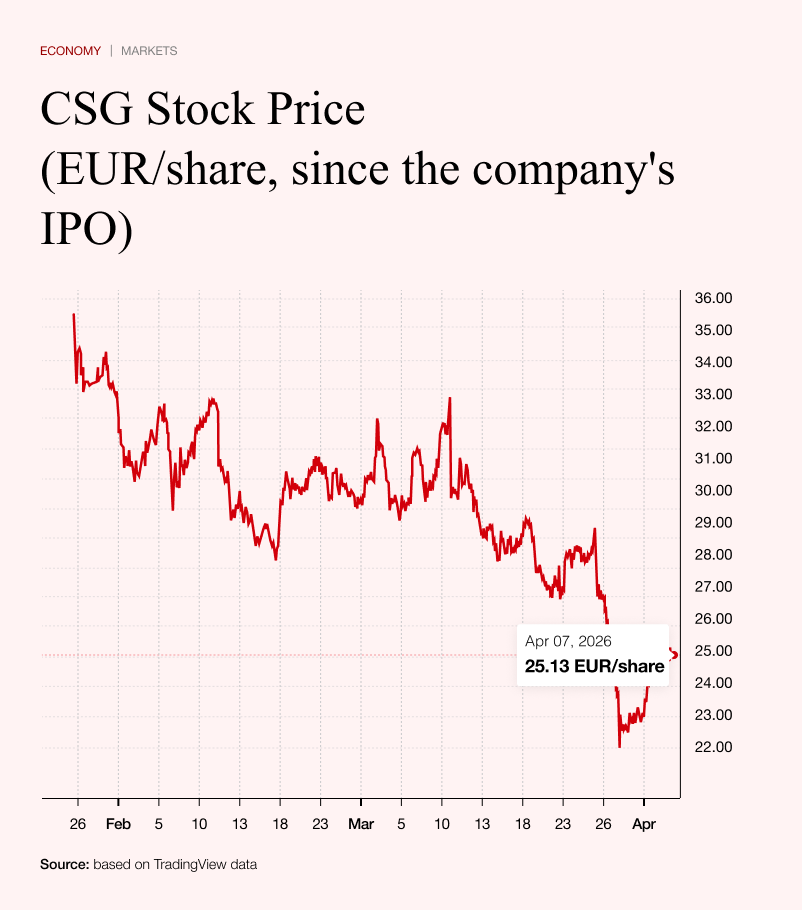
While management timed the offering at the peak of geopolitical and defence-sector euphoria, the prospectus downplayed key fundamental risks. Only later did those risks emerge: multi-billion-euro option claims by minority shareholders, the exclusion of a Spanish munitions subsidiary from NATO purchases due to a corruption investigation and the apparent inflation of future revenues through non-binding framework agreements in Slovakia.
The combination of these factors was enough to send the shares sharply lower, even below the €25 subscription price for institutional investors. They now risk being forced to hold the shares at a loss unless they sell after the initial enthusiasm fades.