
Making sense of the current chaos is not easy, and trying to predict future developments often feels like a task doomed to failure. Yet even everyday life, let alone politics and economics, cannot do without some sense of the future.
Bismarck’s conception of politics as the ‘art of the possible’ contains a fundamental assumption: a politician must be able to recognise which possibilities are real and which are only apparent. Where this ability is lacking, politics ceases to shape events. Instead, it finds itself being carried along.
This is where today’s foresight runs into its main problem. Analysts often describe the world not as it is, but as they would like it to be. Instead of sober estimation, this produces interpretations laden with expectation and ideology.
The war in Ukraine is instructive in this regard. Some Western commentators initially underestimated Russia’s ability to wage a long war, while others incorrectly assumed that the Kremlin would not cross the threshold of an open military invasion. In both cases, it was not just a lack of information, but a flaw in the assumptions themselves, which were then quickly challenged by reality.
The Chinese ‘forecaster’ on the scene
The root of most flawed geopolitical analysis lies in the prevalence of a moralistic view, where conflict is seen as an inevitable contest between good and evil. While moral judgement is necessary, it should follow objective analysis.
It is precisely because of the absence of this bias that Jiang Xueqin, a widely followed figure in geopolitical forecasting whom some media have nicknamed the Chinese Nostradamus, stands out.
His YouTube channel Predictive History currently has over two million followers. Jiang has to his credit two unquestionably successful predictions, formulated as early as 2024: the re-election of Donald Trump and the subsequent outbreak of an American war with Iran.
Jiang Xueqin’s advantage is undoubtedly his grounding in two cultures – Chinese and Western. He was born in China but grew up in Canada from the age of six. He studied English literature at Yale University, wrote for The Wall Street Journal and now teaches philosophy and history in Beijing. He thus views both civilisations with distance and a healthy scepticism.
He bases his predictions on game theory and the historical thesis of the cyclical decline of empires, familiar from the works of Oswald Spengler and Arnold Joseph Toynbee. But key to understanding his argument is a reference to historian Paul Kennedy and his concept of ‘imperial overstretch’ – that is, a situation in which a great power accrues more global liabilities than it can economically bear.
The parallel with financial analyst Ray Dalio, who explores the succession of global hegemons through major debt cycles and the loss of reserve currency positions, is also crucial. Indeed, Jiang himself refers to the US national debt of 40 trillion dollars as an unsustainable Ponzi scheme, its survival depending solely on the maintenance of the petrodollar.
War as a manifestation of decline, not strength
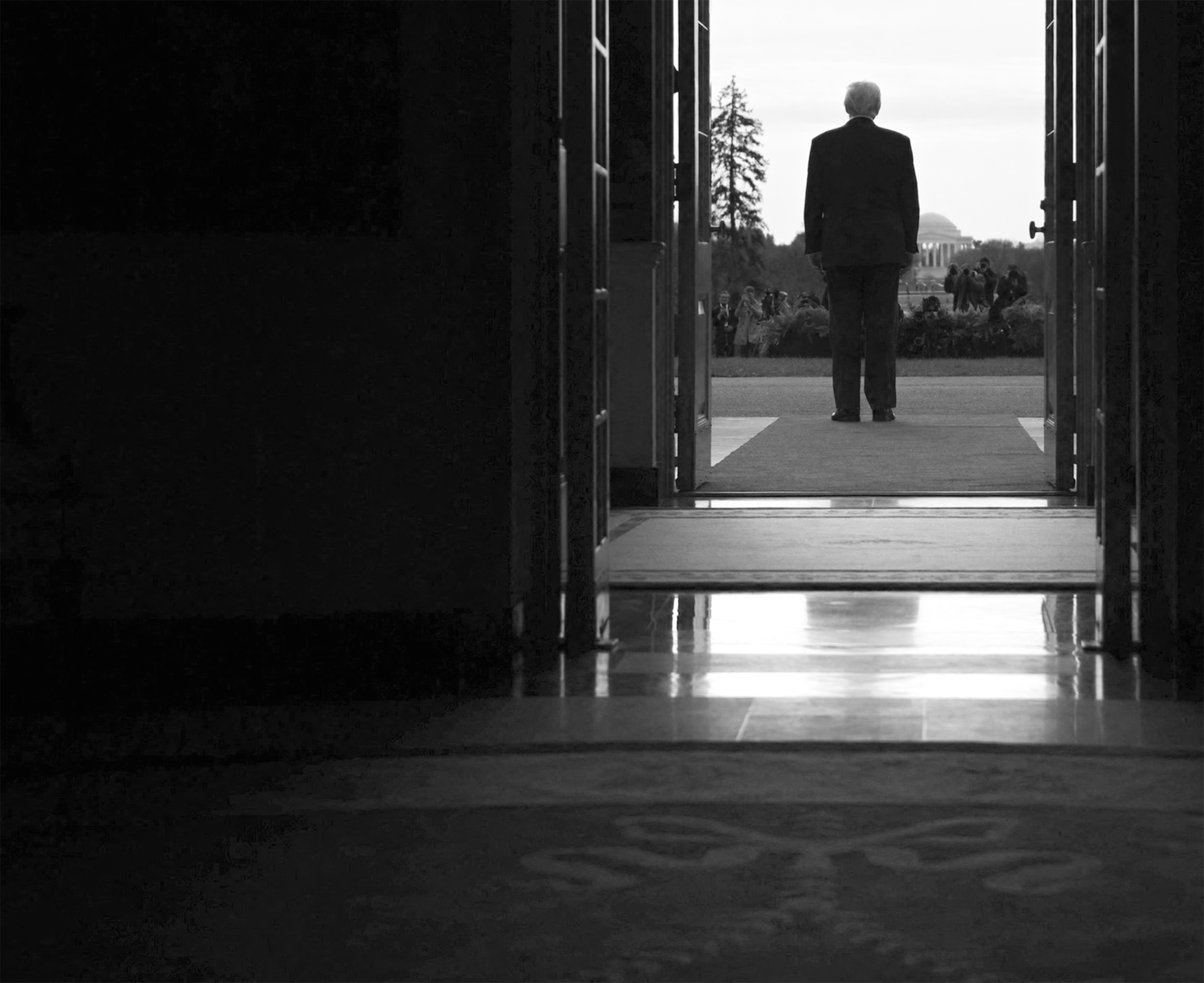
The current war in Iran is, according to the Chinese Nostradamus, a manifestation of the decline of the United States, not its cause. A weakening empire in convulsions is irrationally attacking its surroundings. Rationality in Washington has been replaced by hybris, or fatal pride and arrogance, mixed with deep despair at the loss of global hegemony. Just read any recent speech by Donald Trump, who was originally elected with an isolationist agenda, and the hybris literally oozes out of him.
This American conceit has been reinforced by the recent ‘miraculous’ and ‘bloodless’ operation in Venezuela, as well as by the legacy of the 2003 Iraq war, when the ‘shock and awe’ doctrine celebrated a quick success against a country devastated by sanctions.
The start of the Iranian operation was thus characterised by the pursuit of a lightning decapitation of the regime in the naive belief that the government would immediately collapse. The United States, however, miscalculated badly. The threat of the destruction of Persian civilisation immediately united Iranians around the defence of their own sovereignty and a culture of martyrdom. Instead of a swift collapse, the empire encountered a determined nation in an existential struggle.
The asymmetry of objectives and the trap of a ground invasion
Iran’s enormous advantage is that it has a simple goal: to survive. As long as the regime exists, Iran is the de facto winner.
In the case of the US, the situation is far more complex. The single objective of the operation is not clear, and the administration is offering shifting justifications. Moreover, the war is extremely unpopular with the American public, and Washington faces divisions even among its allies, as Israel yearns for regional escalation, while America’s partners in the Gulf are terrified of their own destruction.
Air strikes are not enough to win, and so the United States may soon face the fatal dilemma of a ground invasion. Its logistical preparation would take at least two years and require up to two million troops. It would mean the reinstatement of universal conscription, or the draft, which would be tantamount to political suicide.
The extreme cost of such an operation would raise the national debt astronomically. According to Jiang, being stuck in Iran’s ‘new Vietnam’ would destroy the petrodollar and plunge the US into an economic depression that would far eclipse the crisis of the 1930s.
The end of individualism and the rise of collectivism
The final note of Jiang’s analysis is chillingly pessimistic and represents a harsh reckoning with the baby boomer generation [the post-war generation born between 1946 and 1964, ed. note]. It is they whom the Chinese Nostradamus blames for having spent their best years in unsustainable material prosperity and extreme individualism, now leaving a devastated world in their wake.
They cling desperately to the remnants of a collapsing empire simply to maintain their comfort. The sobering effect of this mindless consumerism will be extraordinarily cruel, according to Jiang. The old world of globalisation is effectively dead and will be replaced by a permanent struggle for dwindling resources.
Survival in this dark reality, the forecaster argues, will depend on a retreat from individualism and a return to hard collective systems, increased militarisation and more assertive nationalism. He suggests that nations that recognise this shift early and discard the illusions of multiculturalism will have the best chance of survival.
The pioneers of this trend, according to Jiang, are already Israel and Japan. He points to Israel’s increasingly hardline security posture and to Japan’s growing rearmament as early signs of a broader shift.
Only the ruthless test of time will tell whether these uncompromising scenarios will actually come to pass. We will have to wait to see how the whole geopolitical gambit ultimately plays out. For it is the outcome of this historic turning point that will ultimately decide Jiang’s legacy. Either he will attain the status of an elusive strategist, or he will fade into oblivion as another in an endless line of pessimists who see the world only in black.