

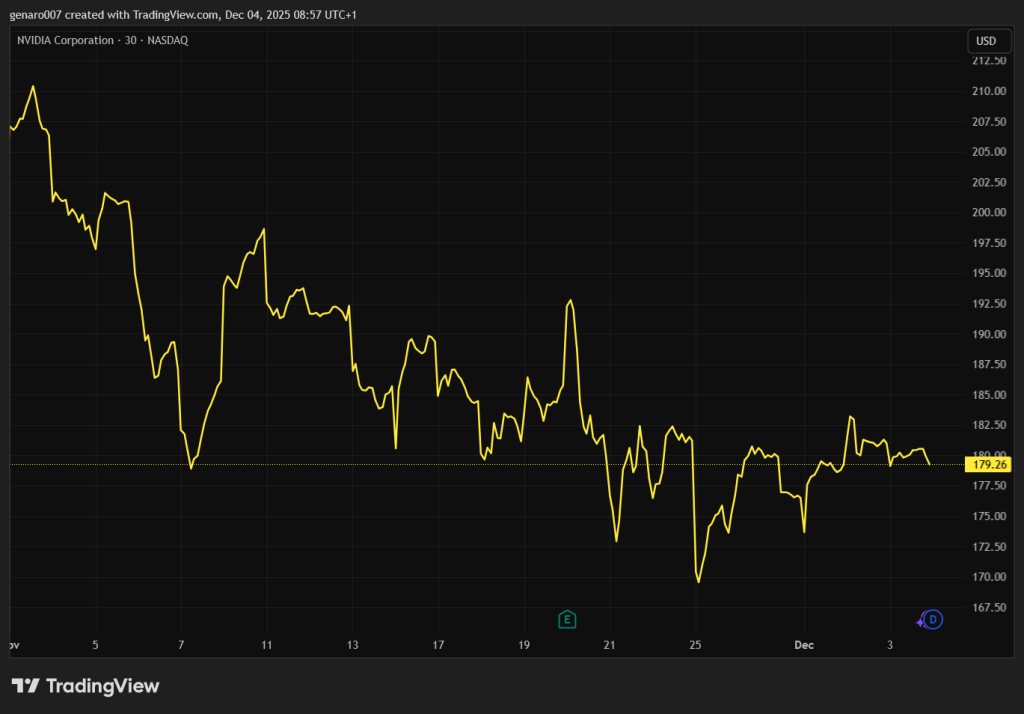
Only the mood around AI has changed since last week. The latter is not seen as a bubble, but instead as a great opportunity. This was confirmed, for example, by analysts at Bank of America, who said that Nvidia shares are now a very good buy. This is true to a certain extent.
Looking at the classic fundamental P/E ratio, Nvidia is worth 44. Meanwhile, other well-known competing companies are significantly more expensive. Broadcom has a P/E ratio of 94 and AMD even 107.
Amazon enters the game
New competition is growing on the chip front. Amazon has announced that it is launching its new Trainium 3 AI chip. This, like Google's chip, primarily addresses the problem of the high cost of training AI models.
Amazon's product should cut costs by up to half compared to systems using predominantly Nvidia's GPU chip. Nvidia has received the news surprisingly positively. It doesn't see it as a competitive threat, but rather a collaborative partnership.
After all, Trainium 3 is not a full-fledged GPU replacement, but a dedicated alternative. Moreover, Amazon will use Nvidia's NVLink Fusion infrastructure on this chip. It is therefore a form of partnership between the two companies.
Nvidia doesn't have to worry about its market dominance just yet, but the new chips from Amazon and Google show that these companies are looking for a cheaper solution to train models. The wealthy tech giants are thus indirectly admitting that the cost of data centers equipped with the latest chips from Nvidia is too high for them.
The third interesting report from the technology sector came from Sam Altman. He, figuratively speaking, pressed the red button and declared that OpenAI is halting all side projects from now on and the main cohort of engineers must focus primarily on further development of ChatGPT. Otherwise, the competition in the form of Google Gemini and Anthropic Claude threatens to catch up with them soon.
With this announcement, Altman has only confirmed that leadership in the AI race is by no means certain. Add to that the fact that DeepSeek has launched its V3.2 version, which according to various tests is on par with ChatGPT-5, understandably at much less cost, and 2026 is going to be a very interesting year indeed.
It may no longer be an era of dominance by one company, but a balanced battle between multiple players. It will no longer be just technological superiority that will be the deciding factor, but also capital discipline, speed of iteration and the ability to retain the best talent.
Bitcoin has strengthened risk appetite
The US market is lacking crucial macroeconomic data due to the government shutdown. Still, the probability of a Fed rate cut at the December meeting is nearly 90 percent. The markets are taking this as a fait accompli.
In addition, Donald Trump announced that he has already chosen a new Fed governor, but kept the name of the nominee to himself. It is likely to be his economic adviser Kevin Hassett. What is known, however, is that the person in question will lower rates according to the president's wishes. In any case, the markets are satisfied.
The rise in the stock indices, which has been dragged down over the last two years mainly by the prospect of low interest rates, has thus been saved for the time being. Of course, the uncomfortable question arises as to what will be the next fuel for market growth when rates on the US dollar get back to very low levels. But that will most likely not happen for another year, and that is an unimaginably long time for today's investor.
Therefore, even in the short term, Wall Street is looking for additional catalysts for growth. This is difficult because the December rate cut has already been fully priced into asset prices. The US exchanges have thus woken up to the price of bitcoin and other risky assets.
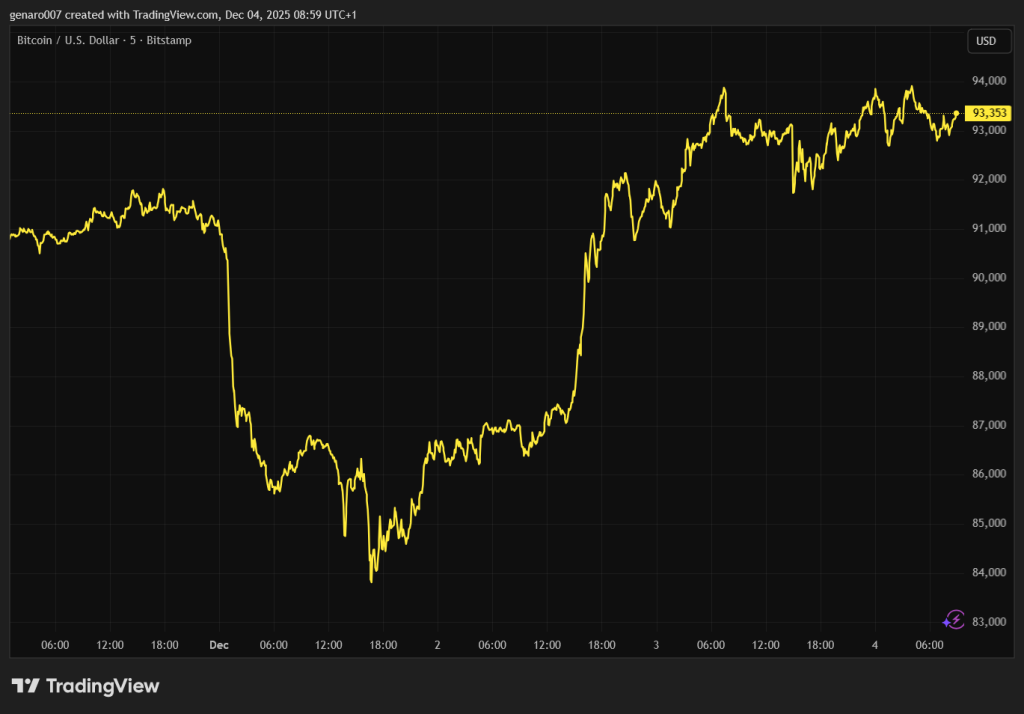
Since Monday 1 December, cryptocurrencies have experienced a huge renaissance. The price of bitcoin has jumped from around 84 thousand dollars on Monday to more than 93 thousand dollars today. That's an increase of more than 11 percent in just three days. And with virtually no significant exchange rate news.
Unless you count the surprising turnaround by Bank of America, which after years of refusing to do so now recommends its clients allocate four percent of their portfolios to bitcoin and other cryptocurrency assets. It's never too late to change your mind. The resurgence hasn't just been about bitcoin. Solana, for example, added more than 16 percent in the same period.
This growth has also affected stock markets, as investors have interpreted the surge in cryptocurrencies as a return of risk appetite in the financial markets. They all suddenly forgot the warnings of Michael Burry or Ray Dalio and started buying risky stock titles again.
The crisis in German industry is far from over
As there is not much macroeconomic data coming from overseas, we will look at the statistics of the Purchasing Managers' Index (PMI) in the German manufacturing industry. In November 2025, this index fell from 49.6 in October to 48.2 points.
Recall that the 50-point threshold is key. Anything above this value means asset growth, below it stagnation or decline. November's figure is therefore a big disappointment. October's 49.6 was relatively optimistic as we approached the 50 threshold. November showed once again that German industry is suffering.
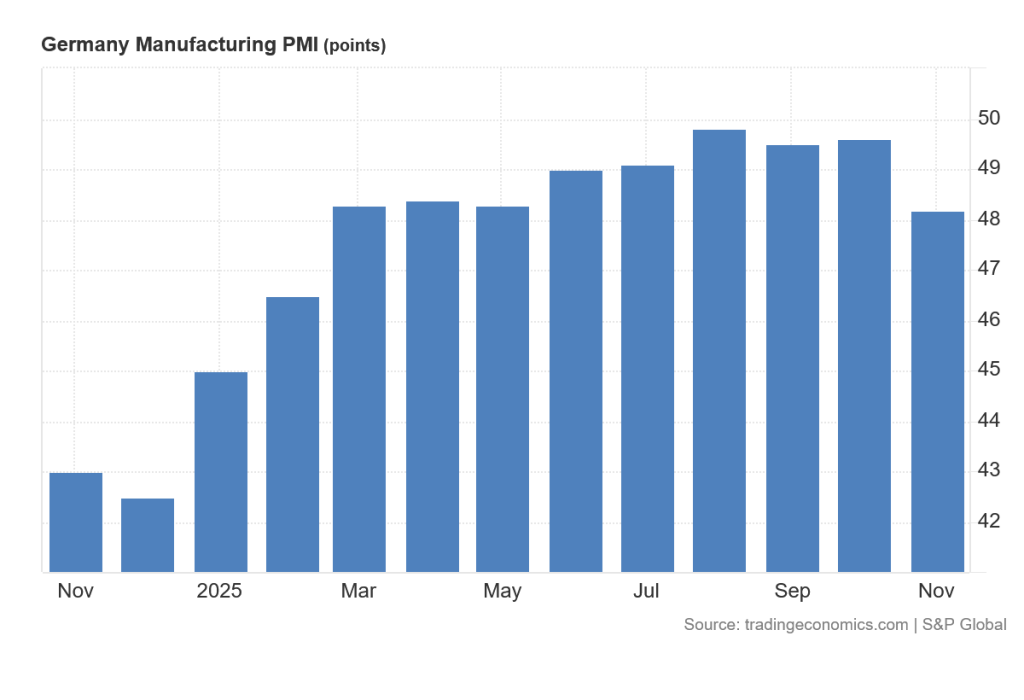
The decline was mainly caused by a lack of new orders. German goods are not in demand abroad, especially in Asia and North America. German industry has thus been going through a difficult period over the past three years. There is no improvement on the horizon. It is only a matter of time before this slowdown is fully reflected in the Czech Republic and Slovakia, for which German companies are a key trading partner.